
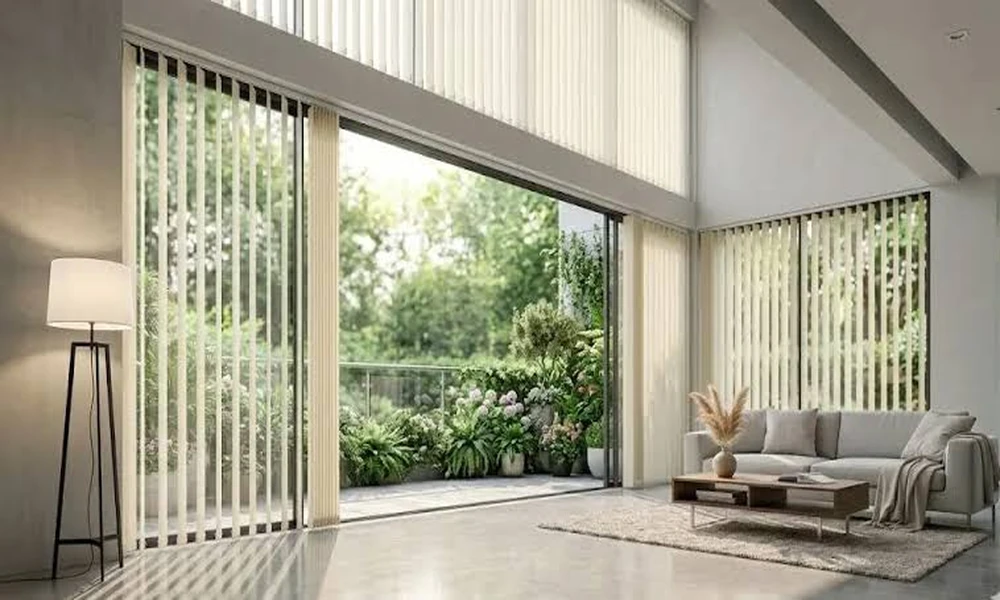
Take two tall openings a few streets apart. One is the balcony sliding door of a three-bedroom condominium unit. The other is the full-height glass front of a small accounting office on the second storey of a shophouse. Both owners ended up choosing vertical blinds singapore suppliers had fitted for decades, yet for different reasons and with different specifications. Setting the two side by side shows what this unfashionable-looking product still does better than its rivals.
The Shape of the Problem
Tall, wide glass that people walk through is awkward to cover. A horizontal blind across a sliding door must be hoisted fully every time someone steps out, and a wide one is heavy. Curtains work but need wall space to stack. Louvres hanging from a headrail solve it differently: they part sideways like a curtain, in the same direction the door slides, and need only a few centimetres of depth. That geometry is the product’s core advantage.
At the Condominium: A Door in Constant Use
The family opens the balcony door a dozen times a day. Their louvres draw to one side, stacking behind the fixed glass panel so the moving panel is left clear. Nobody ducks under anything. When the door is shut and the afternoon sun arrives, the louvres are pulled across and tilted. Children run through them without damage because each strip simply swings aside and falls back, which no roller or Roman blind tolerates.
At the Office: Screens, Clients and a Street View
The accountants face a different difficulty. Their desks look onto a road, and low sun strikes the monitors each morning. They need glare control without losing all sense of the outside, and they need passers-by on the facing walkway not to read client files. Tilted louvres do both at once. Light enters at an angle and washes the ceiling, the screens stay readable, and the sightline from the street is blocked.
The Tilt: What a Wand Twist Actually Does
Each louvre hangs from a carrier that rotates through roughly half a turn. Edge-on, the strips are nearly invisible and the view is open. Turned flat, they overlap into a continuous wall. In between lies the useful range, where the angle can be set to follow the sun across the day. A showroom displaying louvre blinds for tall sliding doors lets a buyer try this with real daylight behind, the only reliable way to judge a fabric’s opacity.
Choosing the Louvre Material
The condominium chose a dim-out fabric in a soft texture, because the living room wanted warmth. The office chose PVC, which wipes clean and does not fray. Fabric louvres look gentler and come in sunscreen, dim-out and blackout grades, though they mark more easily. PVC is tougher and suits pantries or humid rooms, but can clatter in a breeze. Width matters too: broader strips mean fewer of them and a calmer appearance on large spans.
Weights, Chains and the Bottom Edge
Every strip carries a small weight in a pocket at its foot to keep it plumb. Traditionally these weights are linked by a light chain so the louvres move together. The chain keeps order in a draught but can tangle and is tempting to toddlers and pets. Chainless designs with heavier sewn-in weights avoid that. The family picked chainless; the office kept the chain, since its windows are opened less and tidiness mattered more.
Which Way the Stack Should Go
A decision often left to the fitter deserves the owner’s attention. Louvres can gather to the left, to the right, or split and gather at both ends. On a sliding door the stack belongs behind the fixed pane. On an office window it belongs away from the desk that needs most light. A split draw gives symmetry on a central window but leaves two bundles instead of one. Getting this wrong is annoying daily and expensive to change.
Wind, Fans and Noise
Honesty about drawbacks is due. Louvres sway. With the balcony door open in a breeze they knock together, softly in fabric and more audibly in PVC. Ceiling fans directly in front have the same effect. The condominium family learned to draw the blind aside whenever the door is open wide. Offices with sealed, air-conditioned glazing scarcely notice the issue, which partly explains why the product has remained common in workplaces.
Cleaning One Strip at a Time
Upkeep is where this design is kind to its owner. Dust settles less on a hanging strip than on a horizontal slat. A single stained or torn louvre can be unhooked and replaced without touching the others, provided the supplier still stocks the fabric. Fabric strips are dusted or sponged lightly; PVC takes a damp cloth. The headrail’s carriers benefit from an occasional check so that all strips rotate together.
Matching the Product to Your Opening
Measure the opening and ask how it is used. If people pass through it, if it is taller than it is wide, or if graded privacy matters more than softness, the case is strong. If the room is windy or the look must be plush, curtains may serve better. Decide stack direction, louvre material and chain or chainless before requesting quotations. With those settled, vertical blinds singapore homeowners and office managers order will suit the opening instead of merely covering it.