
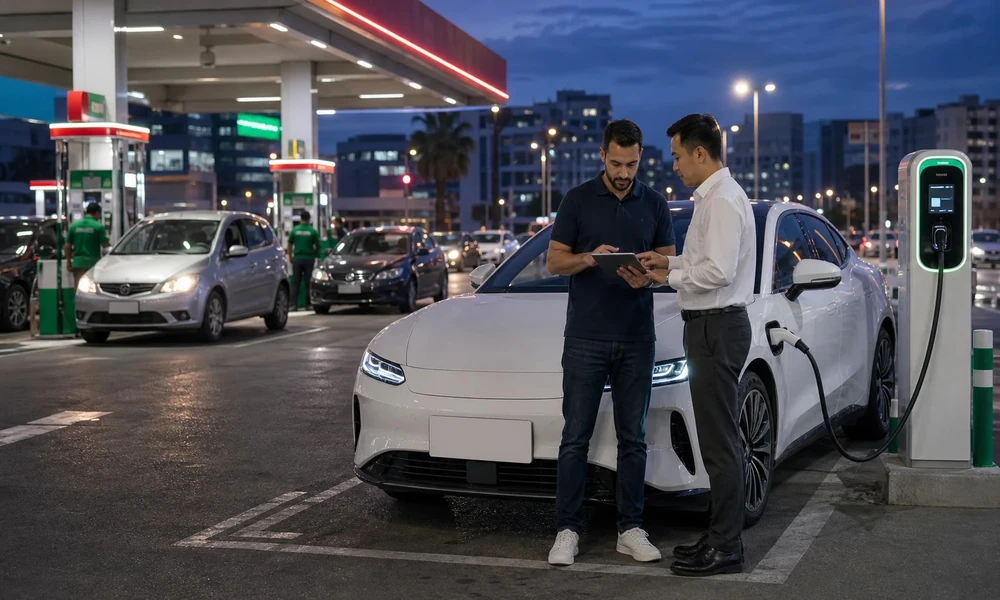
The conversation around Chinese cars has changed in many emerging import markets. A few years ago, buyers often approached them with curiosity and hesitation. Today, more shoppers are willing to compare Chinese EVs, hybrids, and petrol SUVs directly against used Japanese imports, Korean models, European brands, and familiar local favourites. That shift is not only about price. It is about repeated exposure, stronger equipment levels, and more dealers learning how to explain the ownership case.
The Acceptance Ladder
Buyer acceptance usually moves in stages. The first stage is visual interest: a modern cabin, large screen, quiet test drive, or strong equipment list gets attention. The second stage is comparison: the buyer asks whether the vehicle offers more value than an older used import or a lower-trim established brand. The third stage is trust: the buyer asks about parts, warranty, charging, service, software language, resale, and who will support the car after delivery.
Dealers sometimes focus too much on the first stage. A good-looking vehicle can bring someone into the showroom, but the sale depends on the last stage. If the dealer cannot answer ownership questions, curiosity may not become commitment. If the dealer has inspection records, service guidance, charging advice, and clear warranty language, the buyer has a reason to move forward.
Why Test Drives Matter
In many markets, the strongest argument is not a long speech about global market share. It is a controlled test drive. Buyers can feel cabin quietness, acceleration, air-conditioning strength, camera quality, screen response, and ride comfort in a way that advertising cannot fully explain. This matters because Chinese cars are still fighting older assumptions in some markets.
The test drive should be practical rather than theatrical. A dealer can show parking cameras in a tight space, explain driver-assist limits on a normal road, and demonstrate charging or hybrid modes in simple language. That approach makes the product feel usable, not just impressive.
For dealers tracking these broader market changes, the Starvia automotive blog brings together related guides on demand, charging, dealer readiness, and export-market sourcing.
What Still Needs Work
Acceptance does not remove every concern. Buyers may still ask whether a Chinese EV battery will hold value, whether a plug-in hybrid can be serviced locally, or whether a petrol SUV will have spare parts in three years. Those questions are healthy. They show that buyers are seriously considering ownership rather than only looking at price.
Importers should treat these questions as buying signals. A market where customers ask better questions is often a market moving from curiosity into real demand. The dealer’s task is to prepare evidence before the questions arrive: model specifications, inspection photos, parts plan, warranty explanation, charging compatibility, and handover notes.
Another useful signal is who starts the conversation. When only early adopters ask about Chinese EVs, the market may still be narrow. When family buyers, used-car shoppers, fleet managers, and finance partners begin asking practical questions, the category is moving into normal consideration. Dealers should record those questions because they reveal which objections must be solved before larger stock decisions.
The shift in attitude is real, but it is earned one delivery at a time. For deeper context on global demand for Chinese EVs, Starvia’s related article looks at how overseas demand is changing and what dealers should prepare before scaling.